Featured Research
Warwick School Department Fiscal Crisis
Analysis of the Warwick School Department 2025/26 Fiscal Crisis
An evidence-based examination of student enrollment, staffing, school utilization, leadership decisions, and the conditions that contributed to Warwick's school financial crisis.
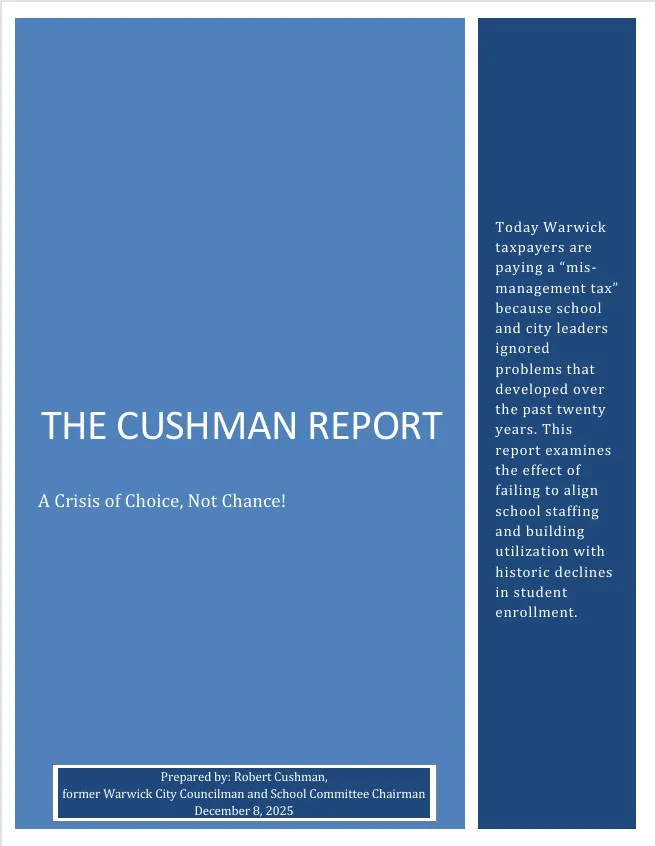
A Crisis of Choice, Not Chance
Explore The Cushman Report
Browse each section of The Cushman Report. Read the report from beginning to end or jump directly to the topics that interest you most.
Start Here
Choose how you want to explore the report
Open an interactive topic below or download the original report as a PDF.
Interactive Report
Table of Contents
Watch & Listen: The Story Behind The Cushman Report
Before exploring the written report, watch or listen to a series of presentations that explain how Warwick's schools evolved over the past twenty years. Beginning with responsible long-term planning and ending with today's school budget crisis, these presentations walk through the key decisions, data, and turning points that shaped the district's financial future. Whether you prefer to watch the videos, listen to the audio, or read the report, this is the best place to begin.
Begin Reading
Preface: A Crisis of Choice, Not Chance
Read why the report was written and how Warwick's fiscal crisis developed over time.
Explore TopicExecutive Summary
Understand the purpose, conclusions, and principal findings of the report.
Explore TopicGap Analysis Methodology
Review how enrollment and staffing changes were compared from 2006 through 2025.
Explore TopicThe Road to Today's School Fiscal Budget Crisis
Over two decades, Warwick's schools transitioned from responsible long-term planning to a growing disconnect between enrollment, staffing, and spending. These three phases reveal how a series of decisions—not a single event—led to today's fiscal crisis.
Phase I — Strategic Alignment
2007–2013
The years when Warwick made difficult decisions to match school resources with declining enrollment. School consolidations, staffing reductions, and long-term planning kept the district financially stable while preserving educational quality. Discover how those early decisions created a sustainable path forward—and why that path was later abandoned.
Explore TopicPhase II — Reactive Alignment
2014–2019
As enrollment continued to fall, the pace of change slowed. Instead of staying ahead of the problem, decisions became increasingly reactive. Staffing, facilities, and spending gradually drifted away from enrollment trends, setting the stage for larger financial challenges in the years ahead.
Explore TopicPhase III — Structural Decoupling
2020–2025
Enrollment continued to decline, yet staffing levels, operating costs, and aging school facilities no longer reflected the shrinking student population. The growing disconnect between students, staffing, and spending ultimately produced the fiscal crisis facing Warwick schools today. See the data that explains how this occurred—and why the warning signs were visible years earlier.
Explore TopicSchool Committee Leadership
Review the leadership decisions and governance conditions that shaped each phase and contributed to today's crisis.
Explore TopicSupporting Research
The report's conclusions are supported by detailed financial analysis, enrollment trends, staffing comparisons, facility utilization data, and historical budget information. These research sections provide the evidence behind the findings presented throughout the report.
Comparing Enrollment Decline to Staffing Levels by Phase
Compare enrollment, staffing, revenue, and alignment trends across all three phases.
Explore TopicCost of Failing to Align
Review the financial consequences of excess staffing, underused facilities, and rising per-pupil costs.
Explore TopicWarwick Spends Millions on Underutilized Schools
Examine school utilization levels and capital spending on buildings operating below capacity.
Explore TopicAvoidable Fiscal Crisis
2020–2025
Review how staffing decisions and delayed corrective action contributed to the fiscal crisis.
Explore TopicCoordinated Consolidation Failure
Review the failure to coordinate facilities, staffing, and long-term fiscal planning.
Explore TopicWarwick Schools Were Not Underfunded
Examine funding trends, enrollment decline, staffing levels, and the district's oversized footprint.
Explore TopicA State-Appointed Fiscal Overseer
Review why state intervention became necessary and what it means for school governance.
Explore TopicAbout the Author
The Cushman Report represents more than an analysis of Warwick's schools—it reflects the commitment I will bring to the Warwick City Council. I believe taxpayers deserve clear, objective, and understandable information about the issues that affect their community. If elected, I will continue producing independent research and analysis that explains city programs, public services, budgets, and major policy decisions in a transparent and straightforward manner. My goal is to ensure every taxpayer has the information needed to make informed decisions and hold their government accountable.