Detailed Narrative
Phase I began with the district’s stability created by the 2006 Warwick Teachers’ Union contract, which resolved three years of expired-contract conditions (2003–2005) and established a new multi-year agreement through 2008. This three-year window of labor stability enabled the School Committee to initiate the only sustained period of alignment in Warwick’s modern history. With predictable labor costs, collaboration between the School Committee and union leadership, and a clear understanding of demographic decline, Warwick schools took the first steps toward correcting decades of operational imbalance.
Phase I benefited from stable and collaborative leadership under School Committee Chairs Chris Friel and Beth Furtado and Superintendent Peter Horoschak. Facing the initial stages of declining enrollment, they initiated staffing adjustments that reflected real shifts in student population. The district pursued gradual reductions in teaching and support positions while maintaining class size standards and program integrity. Their coordinated approach ensured that employment levels began tracking more proportionately to enrollment trends, preventing structural imbalance during the earliest years of decline.
Horoschak in his 2010 budget address wrote, “as we have experience in the past several years, it has become apparent that the only way to keep costs down is to continue to reduce staffing”. He and the school committee provided a unified front that allowed Warwick to pursue long-needed structural reforms without political fragmentation or administrative drift. Friel and Furtado’s school committees supported data-driven decisions about enrollment decline, school consolidation, and staffing alignment, while Horoschak’s administration executed these initiatives with consistency and operational discipline. This partnership created the governance stability necessary for Warwick’s only sustained period of strategic alignment, enabling the district to close schools, realign the elementary footprint, and match staffing levels to demographic reality.
During this period, the committee acted strategically on enrollment projections, most notably those from New England School Development Council (NESDEC), report warning Warwick of significant population decline. Consolidation planning began in earnest. In 2008, two elementary schools, Potowomut and Rhodes, were closed. In 2010 John Green elementary was closed.
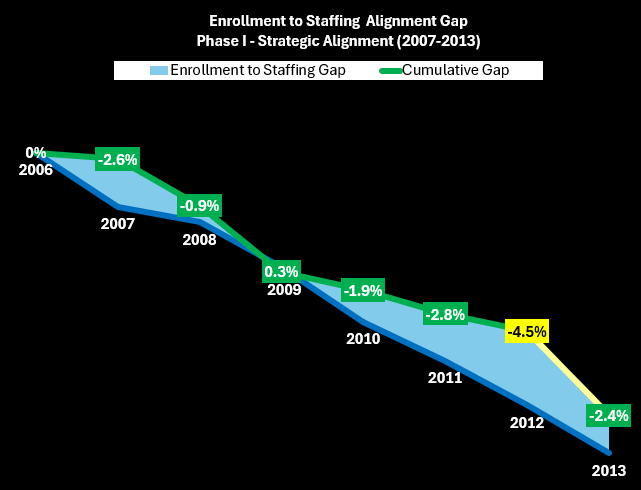
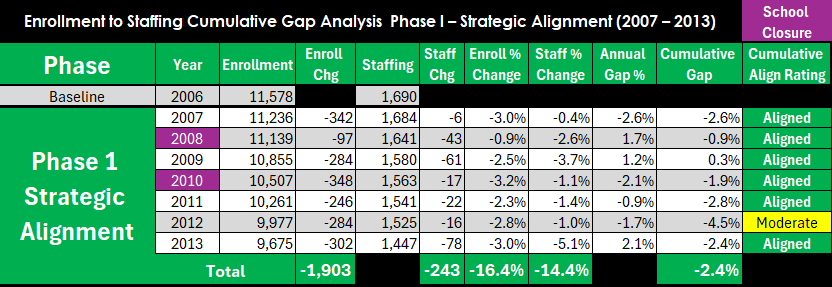
Staffing reductions were tied directly to enrollment decline rather than political pressure. Administrative operations were modernized, and the district’s footprint began the long-overdue process of rightsizing. The gap remained modest, suggesting staffing adjustments were still responsive to student population changes. With staffing aligned to enrollment decline, no significant cost was associated with excessive staffing.
Phase I was the only era in which Warwick demonstrated structural discipline: consolidation occurred, staffing matched enrollment, budgets were stabilized, and the district used long-term planning rather than stopgap measures. It was a period defined by leadership stability, strategic foresight, and a willingness to make difficult but necessary decisions.
Excess Staffing & Cost
Excess Staffing: Low and Controlled
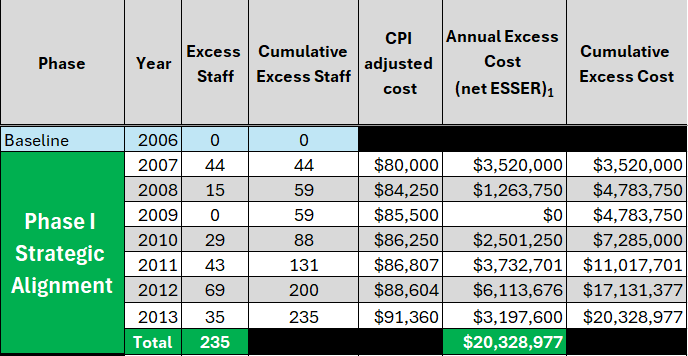
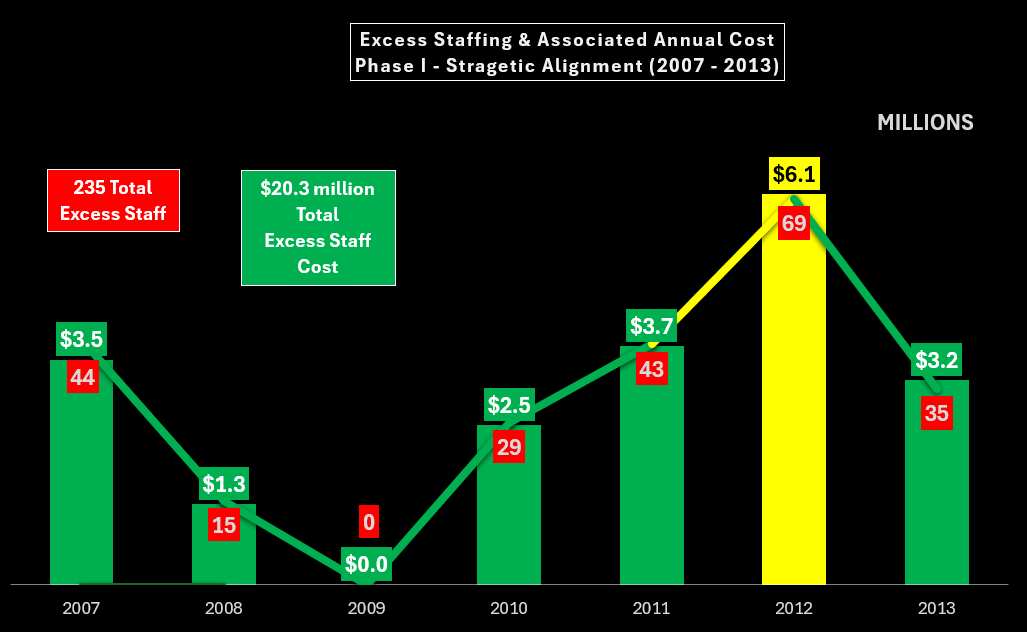
During Phase I, Warwick Public Schools demonstrated a close correlation between declining enrollment and reductions in staffing. The district experienced a loss of 1,903 students (−16.4%), while staffing decreased by 243 positions (−14.4%), resulting in a minimal alignment gap. Excess staff ranged from 0 to 69 full-time employees, with modest averages that posed manageable fiscal challenges. The total excess staff was 235 positions.
The cost associated with excess staffing during this period was$20.3 million, which was largely offset by structural efficiencies achieved through the closure of three elementary schools and districtwide realignments. As Warwick’s operational footprint contracted in line with reduced enrollment, the district successfully controlled recurring expenditures.
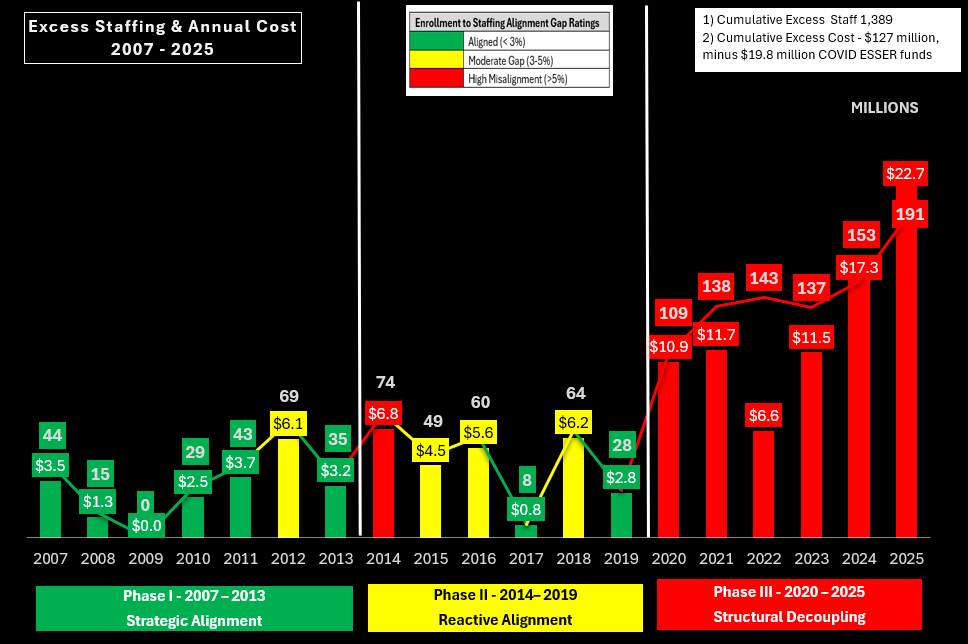
Phase I Summary
- Excess staff numbers were low.
- Cost impact was absorbed by consolidation savings.
- Alignment gap stayed mostly within the “green” (aligned).
- This was Warwick’s only period of fiscal equilibrium.
2006 WTU Contract: Foundation for Consolidation
The 2006 agreement with the Warwick Teachers' Union (WTU) served as the foundational element for Phase I's success. It created three years of labor stability and removed the barrier of operating under an expired contract which would have made consolidation impossible.
In my final public address on December of 2006 before the Warwick School Committee, the administration, union leaders and the public, I provided the intellectual foundation for the three newly elected district Warwick School Committee members to join the two experienced at large members to begin the process of structural staffing and facilities alignment to future enrollment.
I stated that, “City and school spending must be cut. The superintendent along with the new school committee must be willing to make the tough choices and reduce school spending.” I continued, “The city council and mayor must work to coordinate employee benefit packages throughout all departments in the city and in schools, so they do not become a roadblock to consolidation.”
Finally, I stated, “Staffing at all levels throughout the school department and city departments must be reduced. It is time city and school departments adopt the philosophy of ‘doing more with less’.”
The speech focused not only on the responsibility of the school committee but also the new superintendent and the Warwick Teacher Union and WISE union leadership in joining forces to usher in a new era of cooperation so that staffing levels could be reduced, and school department operations becoming more efficient. I even suggested three elementary schools that could potentially be closed, Potowomut, Wickes and Randall Holden.
Operating Under Level Funding
Another defining feature of Phase I was the School Committee’s ability to maintain stability and implement structural reforms during a prolonged period of level funding from the City of Warwick and a five percent cut to the budget in 2011. Warwick schools suffered from the one-time five percent cut allowed by state law for cities and towns to respond to the drastic cut in state aid during the state budget crisis in the early 2010s.
Local tax support for the school department hovered in a narrow range between $118 million and $119 million for a decade between 2008 and 2017, with only minor year-to-year increases. Despite rising fixed costs, utilities, healthcare, transportation, contractual obligations, the School Committees, and superintendents successfully kept the district solvent by making strategic, long-term decisions. Rather than seek large annual appropriations, they pursued efficiency-based solutions, including school consolidation, staffing realignment tied to enrollment decline, and careful fiscal management.
Their approach recognized that in a level-funding environment, sustainability depended not on new revenue but on right-sizing the district to match demographic realities. This governance discipline allowed Warwick to maintain program continuity and make structural decisions, like closing schools, which reduced recurring costs and provided future financial flexibility.
Phase I demonstrates that when leadership is aligned and strategic, Warwick schools can operate successfully even with stagnant funding.
2008 Bond Freeze
Also embedded within this successful period was a critical external shock that would undermine Warwick Schools for more than a decade. In February 2008, the Avedisian administration informed the School Committee that previously approved school bonding—earmarked for essential repair and modernization—would be frozen and likely not issued.
This marked the beginning of a systemic shift. The City effectively ceased funding school capital improvements. The School Department was forced to use its operating budget to repair roofs, boilers, HVAC systems, and building interiors. Millions that should have supported classrooms, staffing, and alignment were instead diverted to emergency facilities maintenance. The City began using redirected bond capacity to support growing municipal expenditures, without a parallel strategy to manage education infrastructure or demographic decline.
Despite this fiscal chokehold, Phase I leadership maintained strategic alignment by taking difficult steps—closing buildings, consolidating students, reducing staff. Yet the bond freeze created structural vulnerabilities that would become fully visible in later phases.
2012, 5% Budget Cut
Although Phase I is marked by disciplined alignment—school consolidation, staffing reductions, and a strategic response to enrollment decline—the seeds of later instability were already being planted by forces outside the school department’s control.
By 2011, Warwick faced the fallout of a statewide fiscal crisis. Under a special one-time statutory provision, Mayor Scott Avedisian exercised authority to cut the school department’s fiscal 2012 local budget appropriation by 5% (approximately $6 million). While legally permissible due to the collapse of state aid, the decision was not accompanied by a coordinated, multi-year restructuring plan between city and school leaders.
Importantly:
- The full 5% cut was absorbed exclusively by the school department.
- The city simultaneously enacted large tax increases over two years and relied on surplus funds to balance its own budget.
- The city budget did not experience a proportional reduction, nor did it undertake major structural reforms.
- No joint city–school strategy was developed to leverage the consolidation gains occurring during Phase I to create recurring budgetary relief for both sides.
In effect, the city’s action forced the school department to contract operationally while the city diverted the fiscal space created by the reduction toward its own unsustainable expenditure patterns—particularly rising pension, OPEB, and personnel costs.
This meant that despite the school committee’s rigorous work in Phase I—closing schools, aligning staffing to enrollment, and strategically managing resources—the long-term financial stability of the district was being undermined by structural decisions on the municipal side.
The city did not pair the school reduction with a comprehensive, multi-year strategy addressing building utilization and workforce rationalization, despite unmistakable evidence that these areas required unified governance. Capital planning suffered, especially with the 2007 bond freeze and the future requirement that the school department was required to make building bond improvements using their own general fund budget dollars.
With the combination of the school committee and the administration reacting slowly to the need for additional school consolidation during Phase II, the structural issues intensified during Phase II and were fully exposed in Phase III. Thus, while Phase I demonstrated alignment discipline, Phase II marked the beginning of structural fragility—and the 2012 cut was a primary causal factor.
For these reasons, any sustainable solution must recognize that the school department’s current crisis is not the result of isolated managerial decisions, but rather the product of long-term structural imbalances created and compounded by both city and school-side actions—and by missed opportunities for coordinated fiscal governance.
The continued argument from critics that additional funding in the current school budget is justified because of the five percent budget cut fifteen years ago is unfounded. The school department contributed to the crisis by ignoring enrollment trends, rejecting, or delaying consolidation. Allowing staffing to grow despite declining student populations, using ESSER funds to hide structural deficits and rejecting the superintendent’s recommendation for required staffing cuts.
The City worsened the crisis by using school savings to support excessive municipal spending, letting pension and OPEB liabilities rise unchecked, not creating a strategic plan to consolidate schools or adjust staffing with new budget funds, and neglecting school capital needs for ten years.