Detailed Narrative
Stability started to wane in 2014. Leadership turnover rose in both the superintendent office and School Committee, which stopped following a long-term school consolidation strategy. Enrollment continued to fall. Consolidation and alignment occurred only out of necessity, not due to an organized plan.
During these years, Warwick closed additional schools and repurposed buildings, including consolidations triggered by severe underutilization. However, these decisions were reactive, not proactive. Staffing reductions were inconsistent: some years saw right-sizing aligned with enrollment decline, while other years stopped progress, rehired positions, or postponed necessary reductions.
In 2014, the School Committee launched a Facilities Master Plan, partnering with SMMA for a comprehensive evaluation. The resulting 2015 plan was one of the district’s most thorough facility assessments in decades.
The report included comprehensive enrollment forecasts, capacity analyses for each building, and options for consolidation. For elementary schools, the report stated that, “the elementary school population will begin to stabilize after 2020, total enrollment is forecast to decrease by 1,090 students, a decline of 12%, between 2014-15 … and 2024-25 school years (ten-year forecast). Two thirds of that decline takes place in the next five years.” At the time the report indicated that Warwick had excess elementary school capacity of 26.5%.
The favored consolidation plan outlined a gradual reorganization of secondary schools—closing Gorton and Aldrich Junior High Schools while converting Warwick Veterans Memorial High School into a middle school—scheduled to begin with the 2016–2017 academic year. In 2015, the School Committee approved this plan, setting up a multi-year transition that connected future investments with demographic and financial trends.
By 2017, Warwick Public Schools experienced ongoing declines in enrollment but saw reduced strategic focus, as thirty-one new positions were added to the fiscal 2018 budget.
The SMMA report recommended consolidating elementary schools over ten years, closing several under-capacity schools to cut costs and improve efficiency. However, only John Wickes and Randall Holden were closed in 2018, and John Brown Francis was converted to an early learning center, falling short of SMMA's broader closures.
As School Committee unity weakened, fiscal and operational progress stalled. During Phase II, Warwick Public Schools faced higher costs, lower enrollment, level funding, and unaddressed problems without making needed strategic choices. The FY2019 and FY2020 budget crises set the stage for Phase III Structural Decoupling.
Even as the numbers suggested alignment had been restored by 2019, the warning signs of Phase III’s structural decoupling were already in place:
- Underutilized schools remained open, increasing fixed operating costs.
- Consolidation opportunities identified in 2015 were delayed or ignored.
- Staffing reductions reflected crisis management, not strategic rightsizing.
- Leadership conflict and internal divisions undermined long-range planning.
- Political decisions routinely superseded operational and demographic realities.
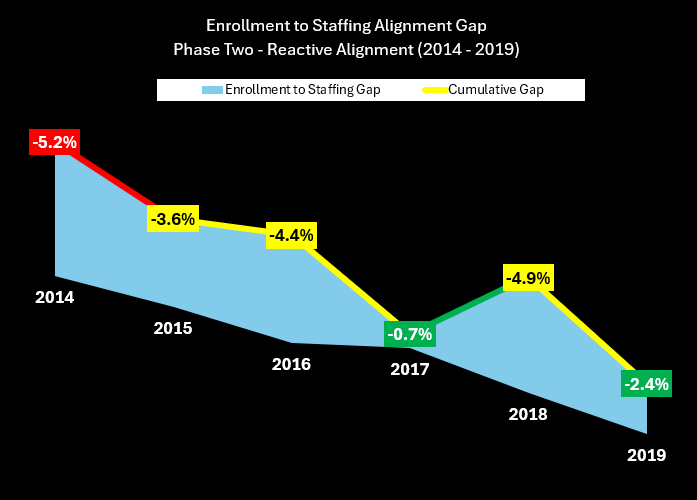
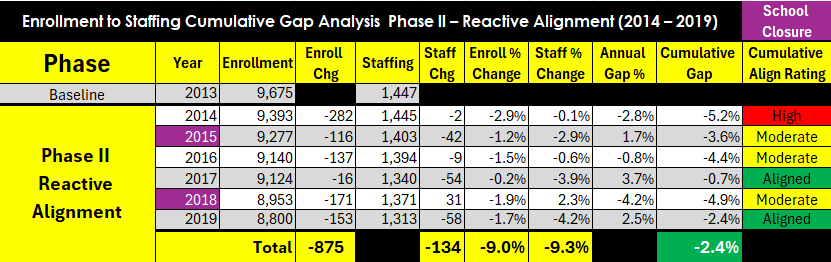
The 2019 staffing cuts were a short-term response to a budget gap, not a strategic move toward stability. They masked structural problems without addressing ongoing misalignment, which is why this period is labeled as Reactive Alignment—the district adjusted only when necessary, not through proactive planning. By 2020, despite a healthy alignment gap, Warwick faced an oversized facility footprint, unresolved consolidation, and lacked a long-term city and school strategy—factors that led to significant misalignment in Phase III (2020–2025).
Excess Staffing & Cost
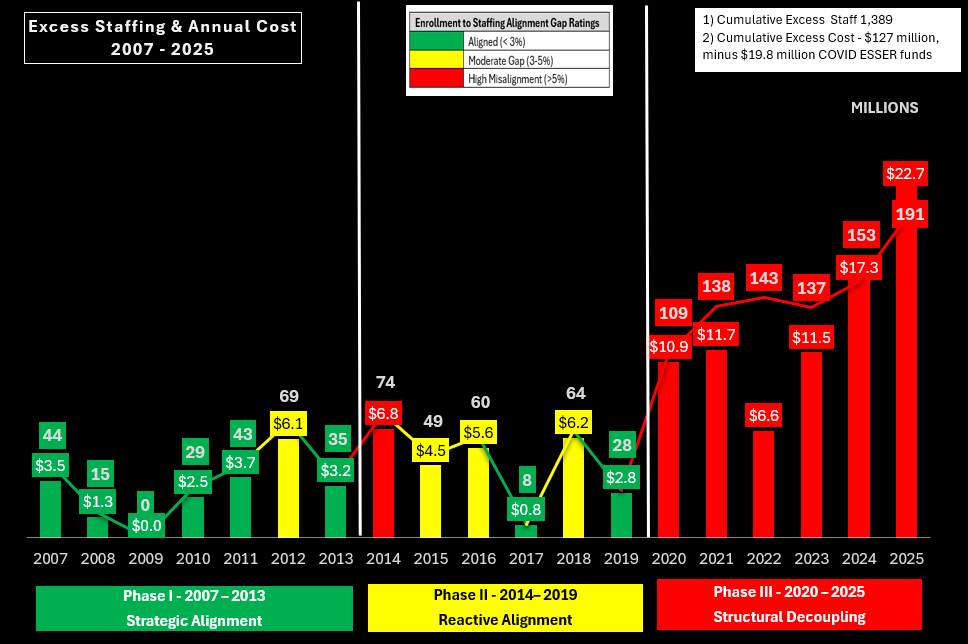
Excess Staffing: Growing and Volatile
Excess Staffing Cost: Increasing, Unstable
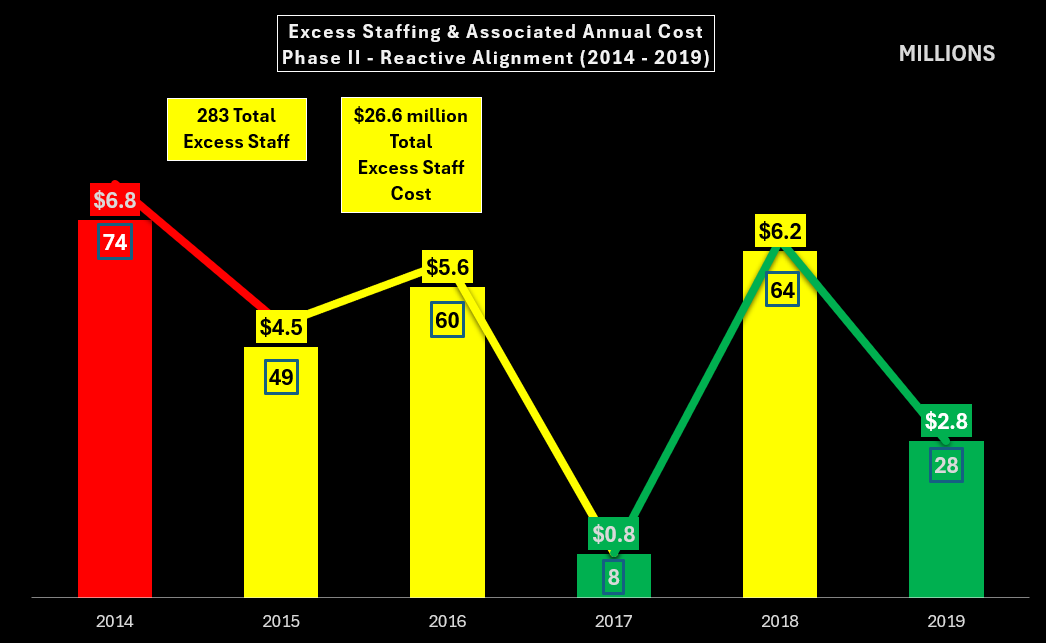
As Phase II began, consolidation stalled and staffing adjustments no longer kept pace with student decline. Enrollment continued to fall, but staffing reductions were inconsistent or superficial. Excess staffing climbed into the 8–74 full-time employees range, with multiple years in the “yellow” (moderate gap).
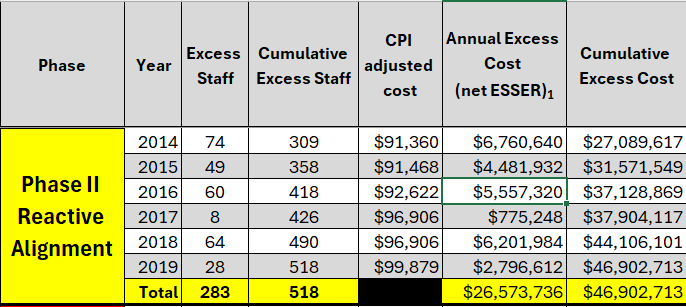
The fiscal implications worsened. Excess staffing cost increased to$26.6 million. Absent strategic realignment, the district survived only through temporary measures, including redirected pension overfunding and deferred maintenance. Instead of structural correction, the district relied on one-time patches.
Phase II Summary
- Excess staffing grew persistently.
- Costs escalated without structural relief.
- Leadership conflict prevented correction.
- The district became dependent on one-time fixes rather than structural solutions.
- This phase ended with Warwick Schools on the brink of crisis.
2019 Budget Crisis
A significant event occurred during the FY2019 budget process. In March 2018, the school committee approved a request for $8.1 million in additional local funding. Subsequently, outgoing Mayor Scott Avedisian announced his resignation in April to accept the position of CEO of RIPTA. His proposed FY19 budget level funded the School Department.
With Avedisian’s departure, Council President Joseph Solomon assumed the role of mayor and inherited a budget framework in which school appropriations were determined. The City Council sought to address the deficit by adding $1.5 million in June to the school budget, while Mayor Solomon further supplemented this with an additional $1.75 million allocated for school-related bond payments and program restorations.
In July 2018, the School Committee authorized $6.6 million in budget reductions to comply with the city-imposed FY2019 appropriation. These measures impacted staffing, athletics, supplies, and operations, but enabled submission of a technically balanced budget as mandated by state law. However, this balance was based on several uncertain conditions, including RIDE waivers, sustained collaboration with the city on cost-sharing arrangements, and anticipated mid-year expenditure reductions.
Shortly afterward, at the August 2, 2018 meeting, these assumptions proved untenable when RIDE denied crucial waivers, rendering the previous budget strategies invalid. The School Committee subsequently voted unanimously to inquire whether the City Council intended to increase school appropriations; a separate vote resulted in the decision to halt payments on bond principal and interest to the city, exposing a renewed deficit of approximately $4.9 million.
By late 2018, tensions between the School Committee and the City escalated, with both parties attributing responsibility for the fiscal shortfall to the other, culminating in the filing of a Caruolo Act lawsuit on December 27, 2018. The lawsuit sought an additional $4.9 million for FY2019.
Following the installation of a new School Committee on January 10, 2019, Chair Karen Bachus and three newly elected members withdrew from litigation, opting instead for mediation with Mayor Solomon and the City Council to address the funding dispute.
The final stages of Phase II were characterized by increasing fiscal challenges. Despite a consistent decrease in student enrollment, staffing reductions did not keep pace, resulting in gaps between needs and resources as well as ongoing budgetary pressures. Efforts at consolidation, frequent political disagreements, and temporary financial remedies left the district exposed to long-term risks. By 2018, these structural issues had reached a critical point.
During mediation, it was revealed that one of the school pension systems had been overfunded by millions of dollars due to contributions exceeding actuarial recommendations. All stakeholders agreed to allocate this surplus to resolve the school department’s deficit, and the mediator's binding decision mandated the use of these one-time funds for school budget deficit elimination. No lasting structural changes were implemented.
Although Warwick avoided continued litigation under the Caruolo Act, the fundamental disconnects between recurring expenditures and revenues persisted. Employing a one-time pension surplus to offset annual operating costs represented a pivotal shift, signaling the district’s move from short-term solutions to ongoing structural challenges.
2020 Budget Crisis
By early 2019, the School Department was already struggling due to a deficit in the FY2019 budget and lingering staffing issues. On April 22, 2019, Superintendent Thornton proposed the FY2020 budget, which called for a 5.86% increase over the previous year. This increase reflected unavoidable costs such as contractual obligations, escalating healthcare and pension expenses, greater special education needs, and basic operations. To maintain vital programs, restore previous cuts, and prevent further reductions, the department requested an additional $8.5 million in local funding.
The request underscored years of incomplete consolidations, a stagnant capital plan, staffing that did not match enrollment patterns, and state-mandated requirements that had driven up expenses. However, Mayor Joseph Solomon’s FY2020 Proposed General Fund Budget only allotted $508,499 in new funding to the School Department—far short of what was asked, dealing a significant blow to its finances.
Faced with this setback, School Committee Chair Karen Bachus and other committee members rejected further consolidation, instead listing forty-six programs—including athletics and special education services—that would be eliminated if funding were not increased. The situation drew public push-back, with Warwick high-school students staging protests at City Hall against the proposed sports cuts.
After tense negotiations, the City Council and Rhode Island Auditor General brokered a compromise, resulting in an additional $4 million for the School Department. As part of this deal, the School Committee agreed in July 2019 to commission an independent performance audit to identify operational efficiencies and suggest ways to reduce spending.
On December 4, 2019, Barton Gilman and the Cumberland Schools Finance Director shared their audit findings with both the School Committee and City Council. The results were unequivocal: teacher labor costs were the highest in the state, per-pupil spending far exceeded the state average, and staffing levels—especially in elementary schools—had not been adjusted to reflect a loss of more than 1,400 students since 2006. Consolidation efforts had stalled, city appropriations remained flat since 2011, and expenditures were growing faster than revenue, leaving the district with a structural deficit.
The report warned that without prompt structural changes, including staff reductions, building consolidations, and administrative realignment, Warwick would continue to face worsening deficits. These conclusions echoed with earlier reports by NESDEC and internal budgets, confirming that Warwick’s financial troubles were systemic rather than temporary.
Councilman Ladouceur asked Barton Gilman’s auditor to rate Warwick’s financial condition from 1 to 10, with 10 being worst; the auditor replied that Warwick was “closer to a 10, if not a 10.” The auditor described Warwick’s school budget as “a fiscal train wreck” in another presentation.
According to the school department’s Five-Year Forecast, adopted on November 12, 2019, the district anticipated a $6.1 million deficit for FY2021, $3.5 million for FY2022, and $5.7 million for FY2023.
Competing factors—including internal financial realities, political promises, and a lack of coordinated strategy between the city and school department—meant core fiscal problems persisted into 2020. The 2019/2020 budget crisis thus marked a turning point, shifting Warwick from reactive adjustments to full structural separation that set the stage for Phase III.