In 2015, Warwick Public Schools commissioned SMMA to conduct a district-wide master plan. SMMA’s conclusion was unmistakable: Warwick had far more school buildings than its declining student population required. The firm recommended reducing the elementary footprint from sixteen schools to ten to twelve over time.
The School Committee acted on this guidance in 2018, closing John Wickes and Randall Holden Elementary Schools and converted John Brown Francis into an early learning center. This represented the first phase of SMMA’s recommended elementary consolidation. However, it was only a partial step. Even after these closures, Warwick remained above the recommended footprint with thirteen elementary schools still in operation.
What happened next is the core governance failure. In 2019, just one year after the two elementary schools were closed, Warwick established a School Building Committee to oversee bond-funded capital projects, manage Phase II $56 million elementary school bond implementation, prepare for the Phase III bond planning and oversee the construction of two new high schools costing $350 million.
This committee met continuously from mid-2019 through 2025, spanning more than five years, meeting almost one-hundred times, and overseeing tens of millions of dollars in bond-funded work. Yet after reviewing more than five full years of Building Committee minutes, not once did the minutes reflect the committee discussing elementary school consolidation, building utilization, right-sizing system, or SMMA’s recommended school footprint. For the entire duration of the committee’s existence, elementary school consolidation never entered any conversation.
This absence was not due to building committee member turnover. The individuals who were present when SMMA delivered its recommendations in 2015 are the same individuals who guided the Building Committee from 2019 through 2025. This includes:
- Steven Gothberg, Director of Capital Projects, who has overseen all district construction from 2015 through the present, including the two new high schools.
- Kevin Oliver, Assistant Director of Capital/Construction Projects,working under the capital projects office on bond implementation, project management, and construction oversight. Oliver has been part of the same facilities leadership team that has shepherded projects from 2019 through 2025, giving him direct involvement in decisions to invest in underutilized buildings and to proceed with large-scale projects without revisiting consolidation.
- David Testa, who was a member of the school committee when the SMMA report was reviewed and warned of excess elementary school capacity, who voted during the 2018 elementary school consolidation, and who continues to serve on the school and Building Committee today.
A. Bond Expenditures on Underutilized Schools
Gothberg, Oliver, and Testa had full knowledge of SMMA’s recommendation to transition toward 10–12 elementary schools. They were present at the 2018 closures. They were in the room for every major bond decision from 2019 through 2025. And yet at no time did they introduce, ask, or consider the need for further consolidation—even as enrollment continued to decline and utilization fell sharply in several buildings.
In 2019, when the Building Committee began its work, this report showed that the alignment between enrollment and staffing was slipping into high misalignment. Just when more consolidation needed to be considered. By 2024, the alignment gap has jumped to catastrophic levels at -15.5%.
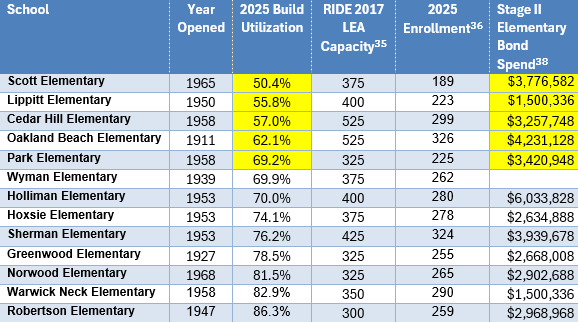
Using the district’s own capacity and enrollment data, at least six elementary schools in 2019–2025 were operating far below reasonable utilization thresholds. These were exactly the types of buildings SMMA warned would eventually need to be closed or consolidated. Instead of evaluating them, the district spent tens of millions of dollars on capital projects at underutilized schools, including mechanical renovations, envelope reconstruction, ADA work, and large-scale interior upgrades.
Over $16 million of Phase II Bond funding was spent on low-utilization schools such as Cedar Hill, Park, Oakland Beach, Scott, and Lippitt. These investments were made without any documented consideration of whether the buildings should remain open or if other schools should be closed and redistricted to increase capacity in the renovated schools.
By ignoring SMMA’s long-term guidance—and by failing to even raise consolidation as an agenda item from 2019 to 2025—the administration and committee leadership allowed Warwick to drift further from a sustainable footprint. The result is a district that still operates too many buildings for too few students, has exhausted tens of millions in bond funds on structures that may not be needed long-term, and now faces a dramatically larger capital obligation as it pursues two new high schools while elementary utilization continues to fall.
The record is clear: Warwick began to follow SMMA’s consolidation roadmap in 2018, but it abandoned the plan entirely in 2019. The officials who knew the plan, guided the plan, and were responsible for carrying it out did not do so. Instead, they stood by as demographic, fiscal, and operational realities demanded action—and spent tens of millions of dollars reinforcing a footprint SMMA warned was unsustainable a decade ago.