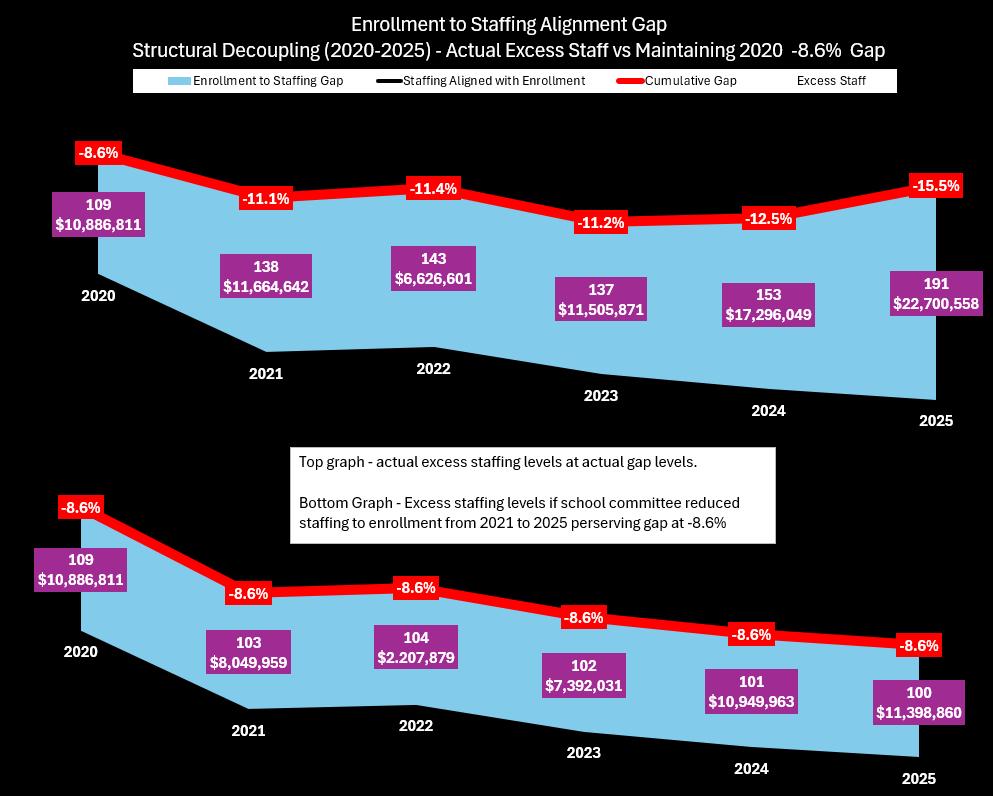
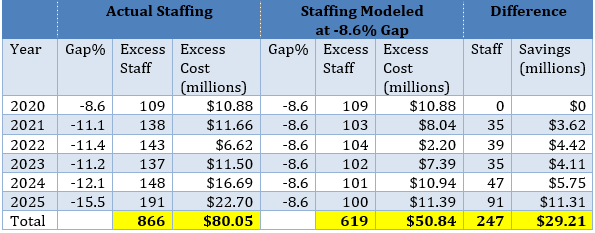
To prove that the Warwick School Department 2025 fiscal crisis was avoidable, an analysis was performed on what would have happened if the school district had simply aligned its staffing to enrollment decline from 2021 to 2025. If the district had done only that, instead of adding more staff as enrollment went down, it would have ended up with 247 fewer excess positions, saving $29.2 million over those five years.
This proves unequivocally that revenue was not the limiting factor. Rather, the crisis was caused by decisions to expand and maintain excessive staffing levels far beyond what enrollment or city funding could sustain.
A. Governance Failure at the Core
It also demonstrates that the core problem was not insufficient city appropriations, but the School Committee’s choice to continue adding staff in an environment of sustained enrollment decline. The increases in local funding, $24.4 million plus the $19.1 million in ESSER funds in Phase III, were more than adequate even as enrollment declined sharply and facility utilization plummeted. Under any standard of fiscal management, these increases should have been more than adequate to operate the district efficiently.
The school committee and the administration did not need to reach a -15.5% staffing misalignment by 2025. It did not need to add 247 more excess positions. It did not need to incur an additional $29.2 million in structural cost overruns. It did not need to burn through its $19.1 million ESSER funds to maintain an unsustainable workforce. The school committee should not have driven former superintendent Thornton out of the district by ignoring his enrollment-based staffing reduction plan and rejecting his plans to lay off teachers. The department failed to consolidate schools despite clear utilization data and engineering reports and it approved labor contracts without identifying offsetting reductions.
If the School Committee had simply held staffing at 2020 -8.6% gap without even improving alignment or implementing consolidation recommendations, the district would not be in fiscal freefall today. The FY2025 crisis, the multi-million-dollar deficits, and the request for state intervention were all preventable.
- 2020–2025 staffing misalignment:871 cumulative excess staff
- If 2020 gap is maintained through 2025:Cumulative excess staff falls to 619
- Difference:247 excess staff unnecessarily added
- Avoidable Spending:$29.2 million
B. If Staffing Levels Were Reduced with Enrollment Reductions
The top graph in the chart below shows a graphical presentation of the actual cost of the Phase III excess staffing cost. The one second graph shows that, if staffing from 2021 through 2025 aligned with enrollment reductions, the district would have reduced excess staffing by 247 positions, saving $29.2 million.