Detailed Narrative
Although the Barton Gilman audit provided clear conclusions, the School Committee did not implement its findings. In the months following the report, instead of adjusting staffing to reflect declining enrollment, internal disagreements among committee members increased, and political discourse overshadowed the technical recommendations of the audit.
This lack of alignment became apparent on May 12, 2020, when, under Chair Karen Bachus, the School Committee voted against issuing certified teacher layoff notices for the FY2021 budget. Superintendent Philip Thornton had prepared a budget that included targeted staffing reductions consistent with both enrollment trends and the audit's recommendations but was overruled. While Dr. Thornton’s plan was based on student enrollment decline, the committee’s vote was influenced by external pressures.
This decision marked a significant turning point, indicating the School Committee’s reluctance to undertake structural measures identified as necessary by the audit. Even though enrollment continued to decline and forecasts projected ongoing decreases, the committee opted to maintain staffing levels that both the audit and the district's five-year forecast considered unsustainable.
Furthermore, this occurred at the onset of the COVID-19 pandemic, during which temporary federal stimulus funding concealed issues related to personnel and facility alignment.
By rejecting certified teacher layoffs in May 2020, the committee effectively discontinued efforts toward alignment. This demonstrated that, despite having access to a comprehensive, third-party, evidence-based stabilization plan, fiscal discipline was subordinated to internal disputes and public pressure.
As a result, Warwick moved toward structural decoupling, where deficits reappeared rapidly, staffing diverged further from enrollment realities, and governance challenges impeded corrective action.
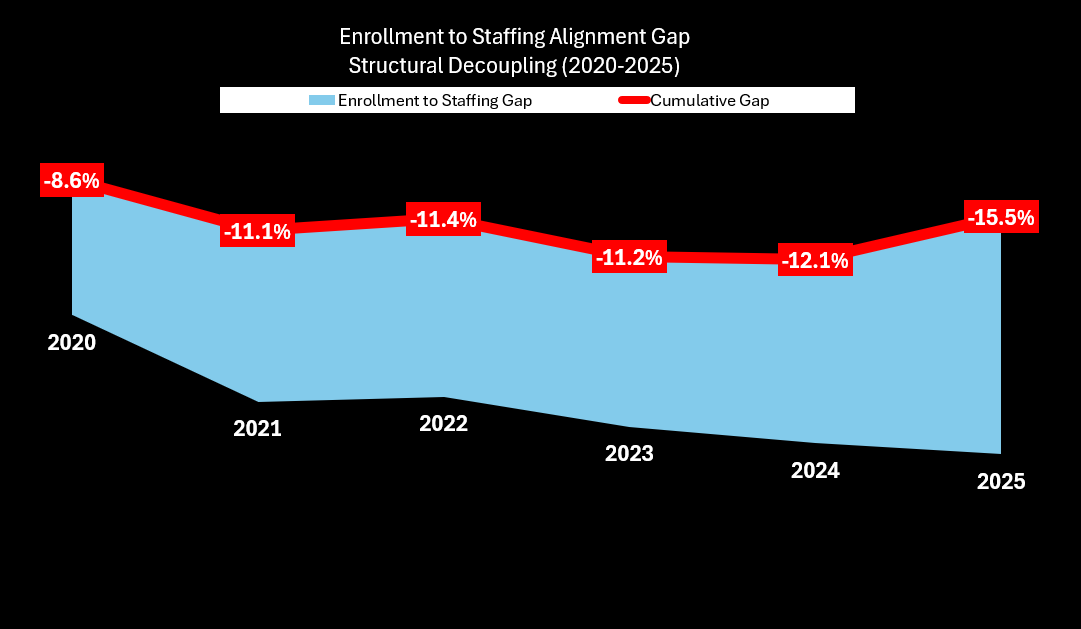
By the end of fiscal year 2020, the Warwick School Department had slipped into a high-misalignment gap of -8.6%. The district never recovered from this gap as it only grew wider in subsequent years.
Excess Staffing & Cost
Excess Staffing: Explosive and Unchecked
Excess Staffing Cost: Severe and Unsustainable
Phase III marks the collapse of the enrollment-to-staff alignment system.
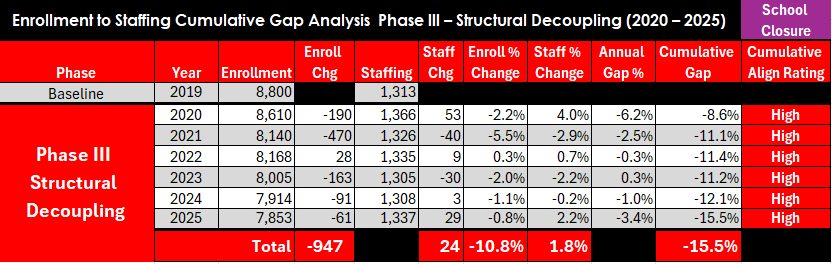
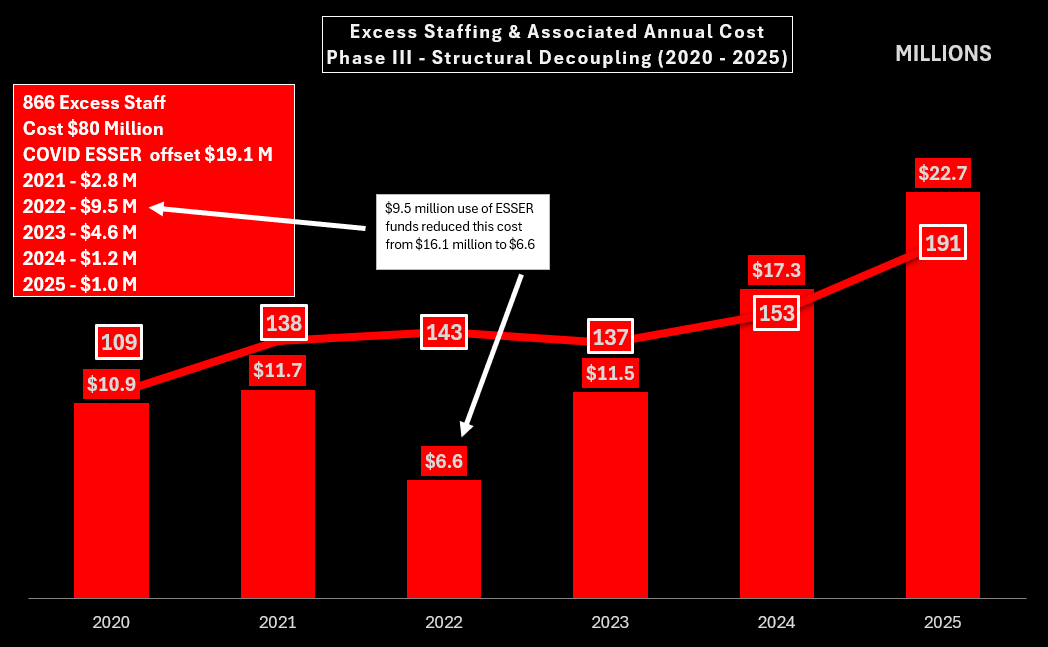
Despite losing 947 students (−10.8%) from 2019 to 2025, Warwick increased staffing by twenty-four positions (+1.8%). Excess staffing ballooned from twenty-eight full-time employees in 2019 to 191 full-time employees in 2025, an increase of more than six times from pre-COVID levels in 2019.
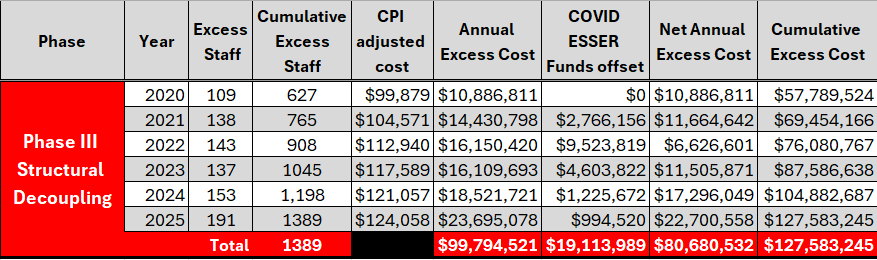
The cumulative number of excess positions for this phase from 2020–2025 was 871. The approximate excess cost was $80 million.
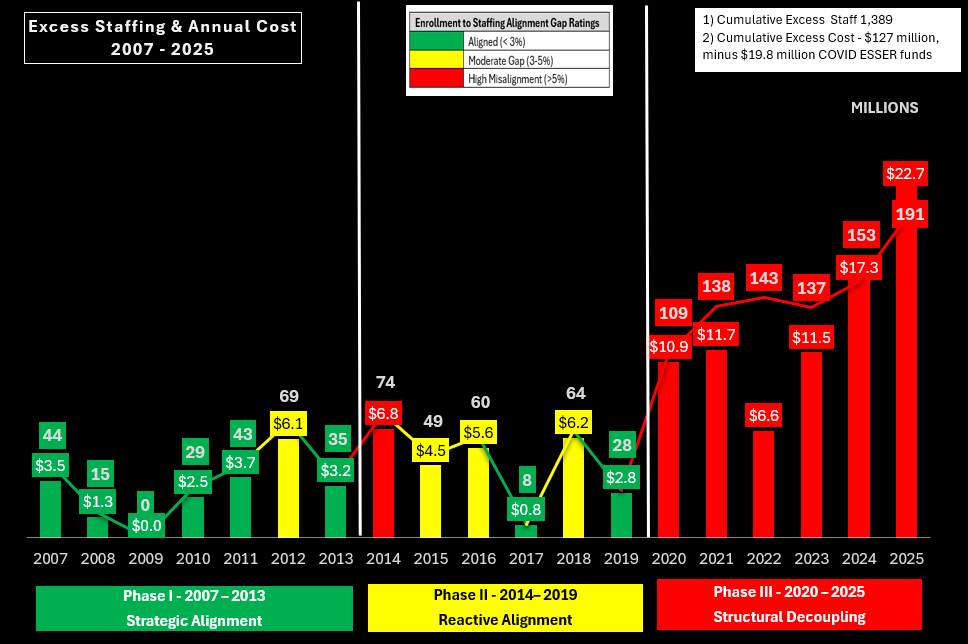
This growth was accelerated by:
- The School Committee’s refusal to issue layoff notices in 2020.
- School Committee Chairwoman Judith Cobden excluding Superintendent Thornton from teacher contract talks.
- A teacher contract that increased recurring costs while enrollment fell.
- Superintendent Thornton’s warning that one-time ESSER funds were propping up overstaffing.
- Superintendent Lynn Dambruch ignoring Thornton’s warning and continuing to use ESSER funds for excessive staffing, with no downsizing plan.
By 2023–2025, the alignment gap was in the “red zone” every year, ranging from −8.6% to −15.5%, well beyond any sustainable threshold. Excess staff no longer represented inefficiency—it represented systemic failure.
Phase III Summary
- Excess staff exploded from 28 to 191 full-time employees.
- Excess cost soared past $80 million.
- ESSER funds masked structural deficits.
- Once ESSER expired, the misalignment became catastrophic.
- Led directly to the creation of a state Budget Commission.
2022 Budget Process
The FY2022 budget cycle represents the critical moment where Warwick Public Schools fully transitioned from long-term budget stress into open structural imbalance, revealing a governance system unable to align staffing, spending, and enrollment.
The debates held at the School Committee meetings on April 13 and April 20, 2021, provide definitive evidence of fiscal misalignment, political fragmentation, and the abandonment of data-driven planning.
Superintendent Philip Thornton delivered a comprehensive presentation documenting the district’s deteriorating structural position. Enrollment had declined 13% since 2016, yet staffing levels remained virtually unchanged. Proper alignment required seventy-four professional staff reductions; Thornton proposed a moderate 35 reductions.
Non-staff costs were fixed: $28 million in operations, $12 million for transportation, $12 million for special education out-of-district tuitions, and $3–4 million for utilities and licenses. Only approximately $5 million remained as discretionary expenditures.
Thornton warned that federal ESSER relief could not be used to maintain ongoing staffing levels, stating that Warwick was “overusing ESSER to maintain overstaffed positions.”
This was the district’s final opportunity to realign before federal funds expired. The April deliberations revealed a governance body unable to execute the alignment required to stabilize the district.
Committee member David Testa asserted that declining enrollment made additional city funding unjustifiable and that structural adjustments were required. Judith Cobden and Nathan Cornell opposed staffing cuts, arguing they would “drive students away” and demanded the district request more city money. Bachus acknowledged that taxpayers were still suffering from COVID and that increased local funding was not politically feasible.
The Committee simultaneously rejected staffing cuts, rejected requesting staffing money, yet adopted a budget incapable of balancing. This inconsistency marked the moment Warwick schools lost the ability to right-size itself.
The Bachus vs Cobden Feud
Another destabilizing force in the Phase III era was the prolonged and increasing public feud between Karen Bachus and fellow School Committee member Judith Cobden. What began as policy disagreements over spending priorities and the handling of the school budget evolved into a deep personal and political conflict that fractured the committee at a time when unity was most needed.
Their disputes frequently overshadowed substantive issues, disrupted committee meetings, and eroded public confidence in the board’s ability to govern effectively.
The growing divide between Bachus and Cobden further weakened the School Committee’s ability to act strategically and contributed significantly to the district’s inability to correct its fiscal trajectory in Phase III. Their feud symbolized the shift from the data-driven collaboration of Phase I to the political fragmentation and personality-driven governance that defined Phase III.
On January 12, 2021, the committee’s leadership shifted when Judith Cobden overthrew Bachus as chair, supported by two inexperienced young members who were elected with her.
One of the most consequential results of this change in leadership was the rush by Cobden to negotiate salary and benefit increases with the Warwick Teachers’ Union, intentionally excluding Superintendent Philip Thornton from the bargaining process.
Bachus had been holding steady that significant concessions were needed from the WTU and was holding the line on salary and benefit increases.
This decision broke with long-standing practice and violated the fundamental operational structure of public-school governance. Superintendents are the executives responsible for evaluating staffing needs, aligning personnel with enrollment, projecting long-term costs, and ensuring contractual commitments are financially sustainable.
By removing Thornton from the table, Cobden denied herself the expertise of the one official with the operational authority and data needed to shape a realistic, sustainable labor agreement.
Excluding Thornton from Contract Negotiations
When School Committee Chair Judith Cobden negotiated the May 2021 teacher contract without Superintendent Philip Thornton, she severed the operational link between labor commitments and enrollment-based staffing needs.
Thornton had already presented his FY2022 budget on April 13, 2021, which outlined a rational, data-driven plan to right-size the district in response to a dramatic decline in student enrollment.
Thornton warned that Warwick had lost 1,200 students since 2016—a 13.3% decline—yet staffing had only fallen by 5%. To correct this imbalance, his FY2022 budget recommended thirty-four professional staff reductions.
This was only the first step. Based on a decline of more than 13% in enrollment since 2016, Thornton stated that the district would need an additional seventy-five staffing reductions to bring staffing levels back into alignment with student population levels.
In other words, Thornton’s realignment plan required more than one hundred reductions over several years to eliminate the structural deficit created by declining enrollment.
However, when Cobden signed the 2021–2024 teacher contract without Thornton’s participation, she committed the district to millions in permanent recurring salary and benefit increases that had not been incorporated into Thornton’s budget model.
The contract did not reflect the thirty-four reductions Thornton proposed nor the additional seventy-five reductions needed to align staffing with enrollment. Instead, the contract created a second layer of staffing reductions that were needed solely to pay for the contract itself.
Contract-Driven Reduction Requirements
- FY2023: an additional 20–30 teacher reductions required only to offset contract costs.
- FY2024: an additional 4 or more teacher reductions required for contract sustainability.
- These cuts were in addition to the thirty-four enrollment-based reductions that should have occurred in FY2022.
Combined Staffing Reductions Required, FY2022–FY2024
- Thirty-four positions: FY2022 enrollment-based reductions.
- 20–30 positions: FY2023 contract-driven cost offsets.
- Four or more positions: FY2024 contract-driven cost offsets.
Total: 58–68 required reductions over three years, not counting the seventy-five additional enrollment-based reductions Thornton identified for long-term stability. Thus, in only three years, the district needed to eliminate 133 or more positions to stabilize itself.
But the School Committee took the opposite approach: it rejected layoff notices in 2020, negotiated a costly contract without its superintendent, and refused to implement the reductions required by Thornton or the reductions needed to fund the contract.
This placed Thornton in an untenable position. He was responsible for creating a sustainable budget but was excluded from negotiations that directly undermined his responsibility. The district had adopted contractual obligations that contradicted his fiscal plan, yet he remained accountable for the financial outcome.
Thornton’s departure became inevitable. With his exit, Warwick lost the only comprehensive downsizing and realignment plan capable of stabilizing the school system.
The result was predictable:
- Fiscal deficits in 2024 through 2026.
- A failure of accurate monthly financial reporting that hid overstaffing salary and benefit costs.
- A state auditor warning.
- By FY2025, a crisis so severe it triggered the formation of the Warwick Public School Budget Commission.
The Elevation of Lynn Dambruch and the Abandonment of Alignment
Following Philip Thornton’s departure, the School Committee elevated Lynn Dambruch, a long-tenured Warwick administrator with more than 30 years in the district, to the role of Superintendent.
While her institutional experience could have positioned Warwick to reconnect with the strategic alignment practices of Phase I, Dambruch instead presided over a period of organizational drift.
Despite having lived through every stage of Warwick’s enrollment decline—Phase I: Strategic Alignment, Phase II: Reactive Alignment, and the 2019 and 2020 budget crises—she presented no plan to downsize the district, no staffing realignment strategy, and no blueprint to respond to the Barton Gilman findings, NESDEC demographic projections, or the fiscal warnings embedded in the school department Five-Year Forecast.
Rather than act on the well-documented need for consolidation and professional staff reductions, Dambruch adopted a business-as-usual leadership posture, maintaining inherited staffing levels and operational structures even as enrollment continued to fall and contractual costs rose.
When Dambruch assumed leadership, the district had already lost more than 1,200 students since 2016, yet staffing had barely changed. She knew the system was structurally overbuilt, had direct access to every audit and projection, and had watched the FY2022–FY2024 staffing requirements expand to more than 133 necessary reductions just to restore balance.
Still, she implemented no corrective action. Under her tenure, the district increasingly relied on temporary ESSER funds, optimistic budget assumptions, and deferred personnel decisions to mask the growing structural deficit.
This refusal to confront reality placed Warwick Schools on a trajectory of accelerating misalignment, allowing the staffing-to-enrollment ratio to reach crisis levels and setting the stage for the FY2023–FY2025 fiscal collapse.
Dambruch’s tenure represents a missed opportunity for course correction. Instead of stabilizing the district after Thornton’s removal, she abandoned all structural planning, ignored independent findings, and allowed the district to drift deeper into unsustainable operations.
Her leadership played a leading role in solidifying the systemic breakdown that defines Phase III: Structural Decoupling.
ESSER Fund Misuse
Before he departed, Superintendent Philip Thornton issued one final, critical warning in his FY2022 budget: the district was “over-utilizing ESSER III funds beyond the extent recommended in order to minimize the number of staff reductions.”
Fiscal year 2022 saw the district use the largest amount of the funds, over $9.5 million. Thornton made clear that the district was sustaining overstaffed positions with temporary federal dollars, a decision that would guarantee a structural deficit the moment this one-time funding expired.
His words could not have been more direct: “A deficit budget is inevitable unless staffing reductions aligned with enrollment decline are made.”
| Fiscal Year | ESSER Funds Used | % of Total | Dollars Used |
|---|---|---|---|
| FY2020 | None | 0% | — |
| FY2021 | ESSER I & early ESSER II | 14.5% | $2,766,156 |
| FY2022 | ESSER II & early ESSER III | 49.8% | $9,523,819 |
| FY2023 | ESSER III | 24.1% | $4,603,822 |
| FY2024 | Final ESSER III liquidation | 6.4% | $1,225,672 |
| FY2025 | Estimated ESSER III final drawdown | 5.2% | $994,520 |
| Total | — | 100% | $19,113,989 |
📱 Rotate your phone to landscape or swipe horizontally to view the complete table.
Once Thornton was pushed out and replaced by Lynn Dambruch, this practice continued. Rather than use the ESSER period to realign staffing with enrollment, Warwick used federal relief funds to freeze an inflated workforce in place, even as enrollment continued to drop.
By 2023–2024, ESSER had become a financial crutch supporting dozens of positions that the district had neither the enrollment nor the recurring revenue to justify.
With ESSER funding expired, the underlying misalignment grew from 2019 levels to six times greater by 2025, an unprecedented scale of structural drift. What had been a manageable gap in Phase II became, under Phase III leadership, a runaway imbalance that destabilized the district’s fiscal foundation.
Dambruch’s continuation of Thornton’s ESSER warning—without adopting his plan to reduce staffing—effectively locked Warwick into a crisis trajectory.
The consequences were historic. By FY2024–FY2025, the district’s finances had deteriorated so severely that annual deficits reappeared, monthly financial reporting collapsed, salary overspending exceeded $6 million in 2024 and $9 million in 2025, city officials lost confidence in school fiscal governance, and the district approached insolvency.
This forced Warwick’s elected officials to take the most dramatic action in modern Rhode Island education governance: they asked the Rhode Island General Assembly to pass a new state law stripping the School Committee of its fiscal authority and placing the department under the control of a state-appointed Budget Commission.
This request was not symbolic. It was an acknowledgment that years of ignoring enrollment decline, rejecting staffing reductions, misusing ESSER funds to prop up excess positions, and overriding superintendent recommendations had pushed Warwick into a systemic crisis that local governance could no longer manage.
The misuse of ESSER funds was the catalyst that transformed Warwick’s misalignment problem into a full structural collapse, directly triggering the need for state intervention.