Ward 1 Council Comparison
Compare Bob Cushman’s Pro-Taxpayer Agenda to Councilman Foley’s Tax-and-Spend Record
Ward 1 voters deserve a clear choice. This comparison puts Bob Cushman’s plans to keep Warwick affordable alongside Councilman Foley’s votes, public statements, and record on taxes and spending.
Issue Comparison
Property Taxes
Bob Cushman’s Pro-Taxpayer Agenda
A Plan to Keep Warwick Affordable
Bob has a practical platform focused on tax relief, responsible spending, and long-term planning—not another cycle of tax increases.
Councilman Foley’s Record
A Tax-and-Spend Record
Four Consecutive Property Tax Increases
Foley voted to raise property taxes in 2023, 2024, 2025 and now in 2026. With his track record he will most likely raise your taxes in 2027 and 2028 if he is reelected.
More Spending if the Schools Run Another Deficit
On May 19, 2026, Councilman Foley stated on the record that if the School Department carried out its promised budget measures but still faced a $500,000 or $1 million shortfall in January 2027, he would be one of its strongest advocates for a supplemental appropriation.
That statement cannot be separated from the School Department’s recent financial history. After the School Committee overspent its salary budget by $20 million and accumulated approximately $7 million in deficits over three years, a state-appointed budget commission assumed control of the school budget. The commission established a five-year repayment plan requiring the School Department to reimburse the city for the money taxpayers had already provided to cover those deficits.
Under the current budget, the School Department was supposed to repay approximately $1.1 million to the city. That repayment was formally waived, leaving the city—and ultimately Warwick taxpayers—to absorb the cost once again.
Two days after Foley’s statement, a resolution concerning supplemental funding for the School Department was docketed and referred to the City Council Finance Committee, which Foley has a seat on the committee.
A supplemental appropriation authorizes the city to spend money beyond what was approved in the original budget. Foley did not explain how Warwick taxpayers would pay for that additional spending. It could require drawing down city reserves—despite S&P Global’s warning about recurring school deficits and the risk of further credit downgrades—or obtaining additional tax revenue from Warwick residents through a mid-year tax increase.
The pattern is troubling. The School Department accumulated approximately $7 million in deficits, and taxpayers covered those deficits. The School Department’s scheduled $1.1 million repayment was then formally waived, leaving taxpayers to absorb that cost as well. Now Foley says he would advocate providing as much as another $1 million if the FY2027 school budget falls into deficit.
Ward 1 voters have a clear choice. Councilman Foley’s approach is to provide more taxpayer money without first explaining where it will come from or addressing the conditions that repeatedly produce these deficits.
Bob Cushman offers a fundamentally different approach: right-size school operations, eliminate unnecessary costs, enforce financial accountability, and create a sustainable budget that protects both Warwick’s schools and its taxpayers.
Ward 1 taxpayers do not need a councilman simply willing to write a blank check when a department over spends its budget. Ward 1 taxpayers needs a responsible leader with a real plan to save money.
Listen to Councilman Foley for Yourself
Double-Digit Salary Increases
Foley voted “Yes” on contracts that provided double-digit salary increases without understanding the effect on your property taxes.
No Plan to Control Spending
Councilman Foley has no plan to reduce spending, control costs, or provide tax relief to all Warwick residents.
Issue Comparison
Open Government
Bob Cushman’s Open Government Agenda
A Plan to Open Up Warwick’s Government to Taxpayers
Enhance Access to Information
Make public records and city information easier for every taxpayer to find.
Modernize Council Meetings
Give residents a better way to view online meetings, agendas, votes, and decisions.
Build a Modern City Website
Create a clear, useful website that helps residents find services and answers.
Government You Can Understand
Present budgets, spending, and city decisions in plain language taxpayers can understand.
Communicate Before You Tax
Explain financial problems and proposed solutions before asking taxpayers for more money.
Councilman Foley’s Record
A Record Opposing Open Government
Foley Blocked Open-Meeting Legislation at the State House
Councilman Foley wrote to General Assembly leadership opposing House Bills 7734 & 6180 over consective years, that would have guaranteed members of the public an opportunity to comment on matters listed on a public body’s agenda. The legislation also would have prevented public bodies, such as the Warwick City Council, from avoiding public comment by removing an item from the agenda at the last minute—even after residents had come to testify.
The Council has used this tactic in the past when controversial issues attracted large numbers of residents seeking to be heard.
The Rhode Island Senate passed the legislation two years in a row, at the request of Warwick residents, including Bob Cushman, but the bill failed to pass the House after Foley and others urged House leadership to oppose it even after the Rhode Island ACLU supported it.
Foley Supported Rules Limiting Public Scrutiny of City Spending
Councilman Foley supported changes to City Council rules that impose strict time limits on the consideration of matters before the Finance Committee and the City Council. These limits apply even when the Council is reviewing multimillion-dollar contracts and purchases involving hundreds of thousands of taxpayer dollars. As a result, council members and residents may be denied the time needed to ask questions and fully understand how public money is being spent.
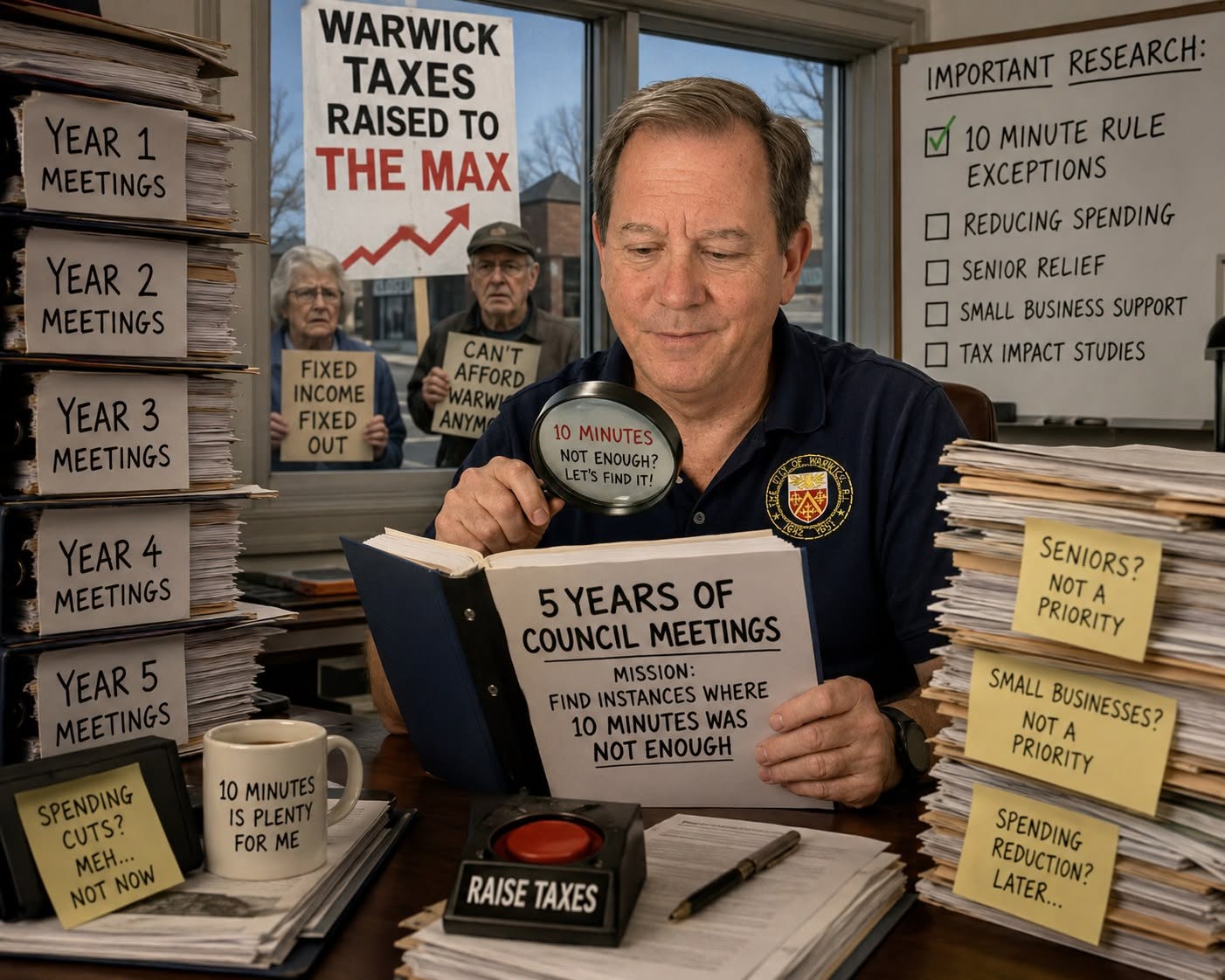
During a May meeting concerning the expenditure of $20 million, Foley emphasized that he had reviewed five years of Finance Committee meetings to determine how often council members requested additional discussion time. Rather than supporting the chairman’s request to allow whatever time was necessary to examine the proposal, Foley defended the time restriction rules.
Foley rarely asks detailed financial questions during Finance Committee or City Council meetings and routinely votes to approve the spending proposals placed before him. Warwick taxpayers deserve a council member who will carefully scrutinize major expenditures, demand clear answers, and present a credible plan to control spending and limit future tax increases.
The Choice for Ward 1
Warwick taxpayers cannot afford more of the same.
Bob Cushman will bring experience, independent analysis, and a taxpayer-first agenda to the Warwick City Council.
Explore Bob’s Full Pro-Taxpayer Agenda