When a Contract Extension Bypasses Taxpayer Safeguards
The $65 Million No-Bid Contract
March 10, 2026
Warwick taxpayers may be interested to learn that the City Council recently voted to extend the City’s healthcare contract without a competitive bid. Because this issue involves both the City Charter and the City’s purchasing ordinances, I want to explain what happened and why I believe the decision undermines an important safeguard for taxpayers.
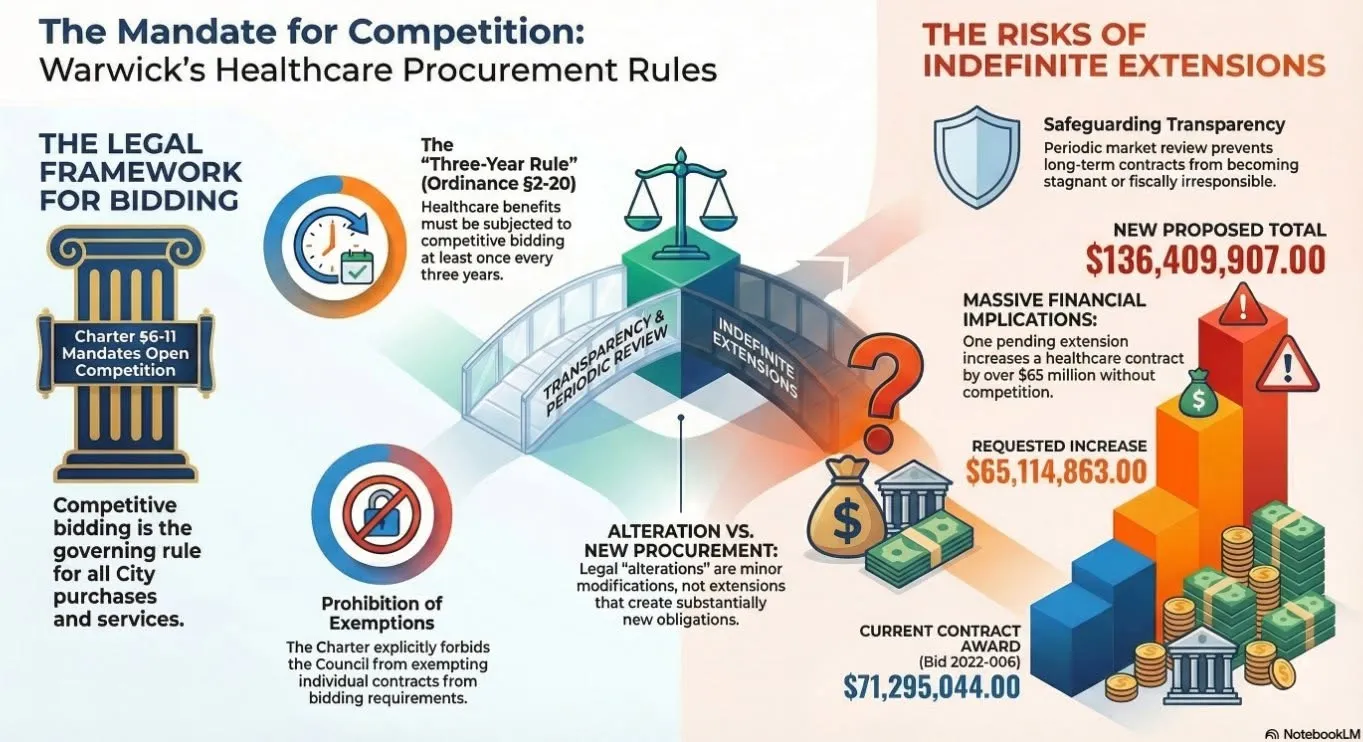
First, it is important to understand what the Warwick City Charter says about purchasing. Section 6-11 of the Charter establishes competitive bidding as the general rule for City contracts. Just as important, that same section specifically authorizes the City Council to establish the rules for competitive bidding through ordinances. In other words, the Charter itself gives the council the authority to adopt ordinances governing how competitive bidding will occur.
In 2007, while serving on the Warwick City Council, I introduced legislation that ultimately became Section 2-20 of the Warwick Code of Ordinances, which requires the City to put its healthcare benefits out to competitive bid at least once every three years.
For many years after its adoption, prior city administrations followed this ordinance and regularly put the City’s healthcare benefits out to competitive bid every three years. The ordinance functioned exactly as intended—ensuring that the City periodically tested the marketplace for the most competitive pricing and coverage available.
In 2021, the City issued a Request for Proposals for medical, pharmacy, and dental insurance benefits. That procurement resulted in a contract running from July 1, 2021, through June 30, 2024.
In February, however, the City Council approved a resolution extending that contract through June 30, 2028. As a result, the same healthcare contract will extend for approximately seven years without a new competitive bidding process.
The healthcare contract involved in this decision is not a small expenditure. The two-year extension approved by the council represents approximately $65 million in additional spending on employee and retiree healthcare benefits.
During the council meeting where the extension was approved, questions were raised about whether the action violated the three-year competitive bidding requirement contained in Section 2-20 of the City’s ordinances. The City Council Solicitor advised the council that another provision of the Charter—Section 6-12, which allows alterations to existing contracts—permitted the extension and that the Charter provision superseded the ordinance.
This is where the legal issue becomes important. Section 6-11 of the City Charter establishes competitive bidding as the rule and specifically authorizes the City Council to adopt ordinances governing how that bidding process will work. Section 2-20 is one of those ordinances. The question raised by the council’s decision is whether a different Charter provision allowing alterations to contracts can be used to override the competitive bidding rules that the Charter itself allows the council to establish.
Based on the solicitor’s legal interpretation, the council voted to approve the extension. However, the issue did not end there.
At the March 9 City Council meeting, Finance Committee Chairman Ed N. Ladouceur moved to reconsider the healthcare contract vote so the council could review the legal issues surrounding the extension. Most of the council rejected this motion.
As a result, the healthcare contract extension remained in place, and the underlying legal question was never resolved. Allowing the contract to be extended to seven years without a new bid defeats the purpose of Section 2-20 of the City’s ordinances.
More importantly, the reasoning used to justify the extension raises a broader concern. If a Charter provision allowing contract “alterations” can be used to override competitive bidding rules adopted by ordinance, then the purchasing safeguards enacted under the authority of the Charter could effectively be ignored.
The purpose of competitive bidding laws is simple: protect taxpayers by ensuring transparency and fair competition when large public contracts are awarded. When a $65 million public contract can be extended without a new bid, it raises legitimate questions about whether the safeguards established by the City Charter and the City’s ordinances are being followed as intended.
Warwick taxpayers deserve a procurement process that is transparent, competitive, and faithful to the laws adopted to protect the public interest.